
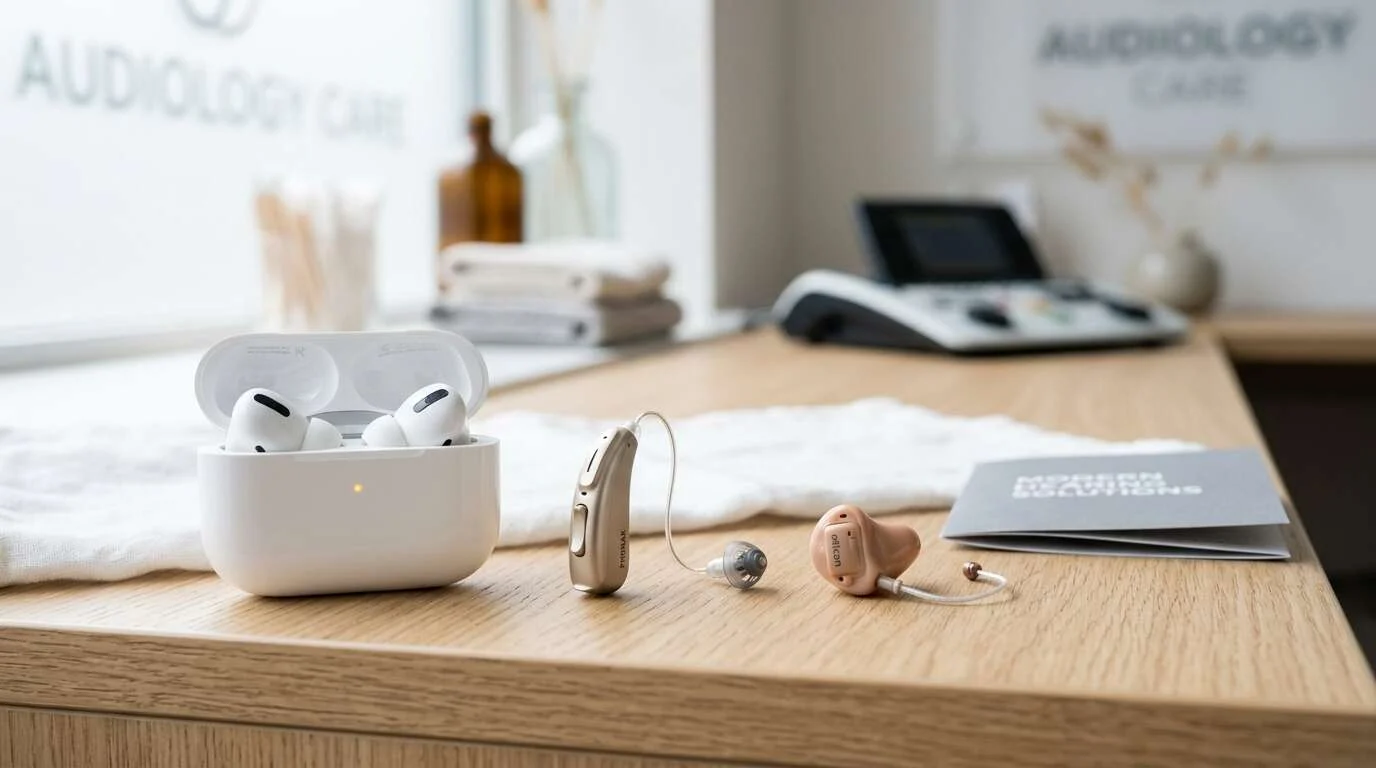
Can AirPods Pro replace hearing aids for individuals living with hearing loss? As consumer technology giants add hearing health features to wireless earbuds, millions of adults are wondering if a 249 dollar pair of Apple earbuds can replace clinical medical instruments that cost significantly more.
Direct answer: Can AirPods Pro replace hearing aids for daily use? No. Apple AirPods Pro 2 and Pro 3 serve as convenient situational listening helpers for perceived mild to moderate loss, but they cannot replace clinical prescription hearing aids. AirPods offer only 5 to 6 hours of continuous battery runtime, create uncomfortable ear canal occlusion due to unvented silicone tips, and cannot treat moderate to severe hearing loss. Prescription medical instruments provide 18 to 30 hours of continuous battery life, customized acoustic venting, and diagnostic calibration through Real Ear Measurement (REM).
In this clinical guide
According to the official FDA over-the-counter hearing aid regulations, over-the-counter (OTC) devices are strictly intended for adults aged 18 and older with perceived mild to moderate hearing impairment. Clinical research documented by the National Institute on Deafness (NIDCD) clinical data on hearing devices underscores that successful long-term auditory rehabilitation requires proper acoustic coupling and individualized frequency prescription.
When asking whether can AirPods Pro replace hearing aids in daily life, patients must evaluate four critical dimensions: battery longevity, ear canal acoustics, speech comprehension in noisy environments, and clinical verification.
What AirPods Pro can do for your hearing
Apple engineered capable audio processing into AirPods Pro 2 and Pro 3. The device uses an on-device pure tone hearing test via iOS. It plays tonal pulses at 250 Hz, 500 Hz, 1000 Hz, 2000 Hz, 4000 Hz, and 8000 Hz. Once completed, iOS generates an audiogram and applies customized frequency equalization to conversations, media, and phone calls.
For situational use, AirPods Pro offer distinct benefits:
- Watching television at home without raising the room volume to uncomfortable levels for family members.
- Conversing in a quiet room across a small coffee table.
- Listening to phone calls, podcasts, and video meetings with personalized high-frequency clarity.
- Serving as an interim backup if your primary prescription hearing devices are being serviced.
Because consumer earbuds carry no social stigma, they encourage hesitant individuals to take their first step toward hearing care. But wearing earbuds for an occasional Zoom call is very different from managing hearing loss all day.
Can AirPods Pro replace hearing aids for all-day use?
When patients ask our audiology team whether can AirPods Pro replace hearing aids for all-day wear, the clinical answer is no. Long-term feedback from patients highlights clear physical and acoustic barriers.
1. Battery life and charging downtime
A medical hearing aid must function from early morning until bedtime. Modern rechargeable hearing instruments from Oticon, Phonak, and Signia provide between 18 and 30 hours of continuous runtime per charge, even with regular audio streaming.
AirPods Pro last approximately 5 to 6 hours with active transparency and amplification enabled. If you insert them at 8:00 AM, the battery runs out by 1:30 PM. You must place them in the charging case and wait 30 minutes for a recharge. For professionals, drivers, and parents, losing hearing midway through the afternoon is impractical.
2. The occlusion effect and ear canal moisture
AirPods seal the ear canal with a tight silicone tip to provide active noise cancellation. This tight seal traps bone-conducted vibrations from your own vocal cords. The result is the occlusion effect: your own voice sounds boomy and hollow, as if you are talking inside a hollow barrel.
In addition, solid silicone tips trap sweat and moisture. In warm climates across Pakistan, wearing unvented earbuds for six to eight hours a day frequently leads to ear canal itching, fungal irritation, and compacted earwax.
Prescription receiver-in-canal (RIC) instruments use open or vented silicone domes and custom acrylic ear molds with calibrated vent channels. These vents let natural sound and fresh air circulate, eliminating vocal boominess and keeping the canal healthy.
3. Speech understanding in noisy dining settings
The primary complaint among adults with hearing loss is difficulty understanding speech in noisy places. When background chatter rises in a busy restaurant or family event, consumer earbuds struggle.
AirPods rely on directional beamforming microphones. In contrast, advanced AI hearing aids in Pakistan employ multi-core Deep Neural Network processors. These chips analyze auditory scenes hundreds of times per second, separating the primary speaker from background commotion while preserving spatial orientation.
Why medical hearing aids cost more than consumer earbuds
Patients often ask why medical hearing aids cost thousands of dollars while consumer earbuds cost a fraction of that amount. Three main factors explain the price difference:
- Miniaturized medical hardware: Hearing aids use ultra-low-power digital signal processors engineered to operate on microamps of battery current for five or more years inside a humid ear canal. They feature hydrophobic nano-coatings and medical-grade durability.
- Real Ear Measurement (REM): Each ear canal has a distinct volume and resonance. A clinical audiologist places a probe microphone near your eardrum to measure actual sound pressure, adjusting 24 to 64 independent frequency bands to match clinical prescription targets like NAL-NL2. Consumer earbuds estimate sound based on an average ear canal, which can under-amplify speech frequencies by 10 to 15 decibels.
- Long-term care and warranty: Medical devices include comprehensive warranties, routine professional cleanings, diagnostic re-testing, and ongoing acoustic adjustments as hearing needs evolve.
Technical comparison: AirPods vs OTC vs prescription hearing aids
The table below summarizes the key differences between consumer earbuds, over-the-counter devices, and medical prescription hearing aids:
How to choose the right solution for your lifestyle
AirPods Pro are suitable if:
- You already use an iPhone or iPad regularly.
- You only need assistance during specific activities like television or video calls.
- You have mild hearing loss verified by a baseline hearing check.
- You want an accessible starting point before investing in dedicated aids.
Prescription hearing aids are required if:
- You need dependable hearing from morning to evening without midday recharging.
- You struggle to understand family conversations in restaurants or group gatherings.
- You have moderate, severe, or asymmetrical hearing loss.
- You want your device calibrated to your ear canal via Real Ear Measurement.
Frequently asked questions
Can AirPods Pro replace hearing aids for seniors?
For seniors who require all-day hearing support, AirPods Pro are rarely suitable. The 5-hour battery life, small touch controls, reliance on iPhone menus, and lack of ear canal venting make them less practical than purpose-built prescription instruments with ergonomic charging docks.
Can AirPods Pro damage hearing if used as a hearing aid?
When configured using Apple’s calibrated hearing test, AirPods follow safe acoustic limits. However, if users manually increase transparency volume without an audiogram profile, loud ambient noises can reach uncomfortable levels. Completing the formal test setup is essential.
Why do voices sound muffled or boomy when wearing AirPods?
This occurs because the silicone ear tip seals the ear canal completely, trapping bone-conducted vocal resonance inside your head. Prescription hearing aids prevent this occlusion effect by using open-fit domes or acoustic relief vents.
Can Android users use AirPods Pro as hearing aids?
No. The FDA-cleared hearing test and custom audiogram compensation require an iPhone or iPad running iOS 18 or later. Paired with an Android device, AirPods function merely as regular wireless earbuds.
How much do prescription hearing aids cost in Pakistan?
In Pakistan, certified digital and AI hearing aids range from basic models (PKR 120,000 to 200,000) to advanced and premium tiers (PKR 350,000 to 700,000+ per pair). The price covers imported hardware from Oticon, Phonak, and Signia, plus comprehensive diagnostic testing, computerized fitting, and ongoing adjustments.
Unsure about your hearing status?
Get an accurate diagnostic audiometry evaluation and clinical ear check at Hearing Care Services. We help you find the right solution for your hearing needs and lifestyle.
Pure Tone Audiometry
Zero-Obligation Guidance