
AI hearing aids in Pakistan are transforming auditory healthcare for individuals who struggle with speech clarity in noisy everyday situations. Whether sitting with family in a busy restaurant or attending a crowded wedding hall, modern artificial intelligence helps wearers follow conversations without listening fatigue.
Quick answer: AI hearing aids in Pakistan use on-chip deep neural networks to process incoming sound in real time. Instead of simply turning up the volume on every noise, they separate human speech from surrounding background commotion. This automatic adjustment provides clearer conversations and natural hearing comfort in busy Pakistani settings.
In this guide
According to the World Health Organization (WHO) guidance on hearing impairment, unaddressed hearing loss significantly impacts communication and cognitive wellbeing. In Pakistan, individuals wearing older analog or basic digital hearing aids frequently complain about the cocktail party problem. In places like busy commercial markets in Saddar Rawalpindi or lively family dinners in Islamabad, ordinary devices amplify background clatter alongside voices, making conversations stressful.
To overcome this challenge, manufacturers developed deep neural network microprocessors. Today, certified AI hearing aids in Pakistan use sophisticated acoustic algorithms to give wearers clear speech understanding even in noisy dining environments.
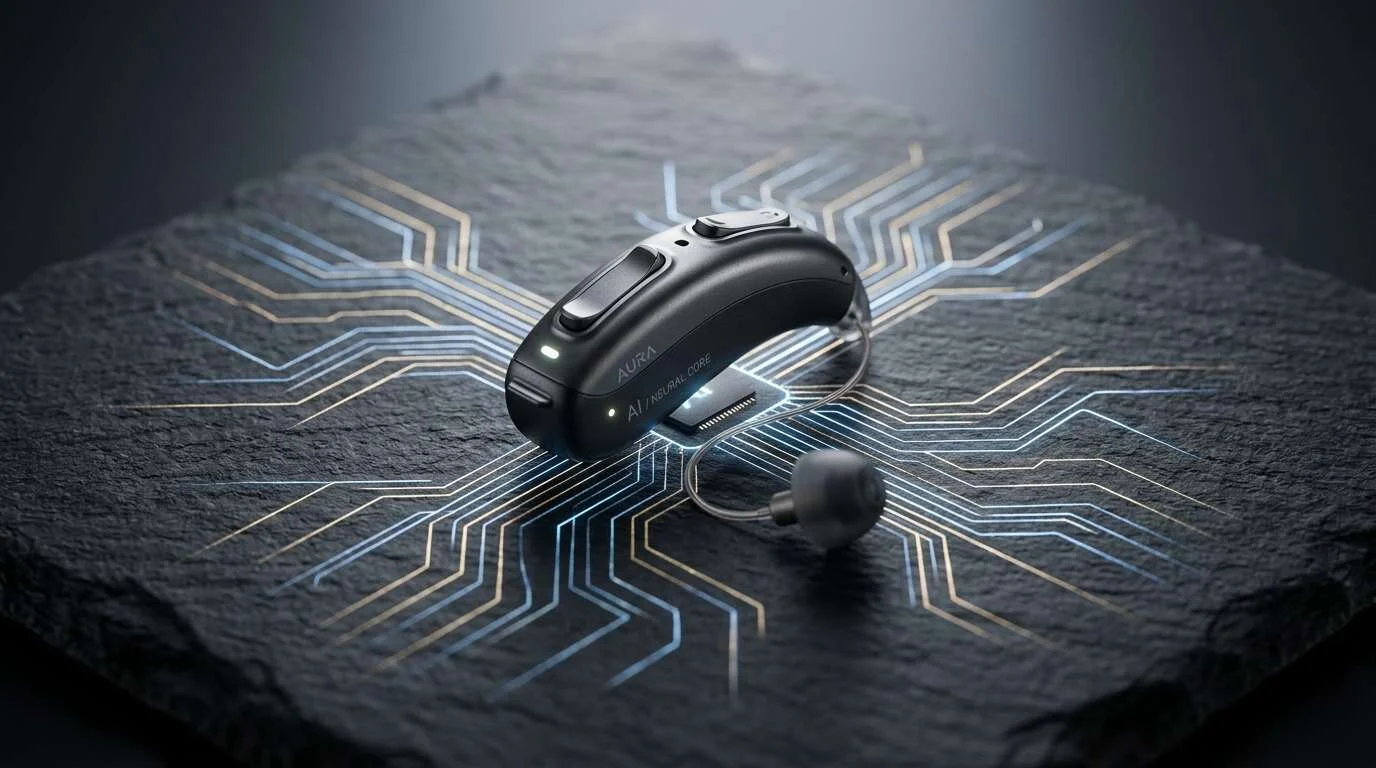
Why AI hearing aids in Pakistan are essential in noisy environments
Traditional digital devices operate on simple mathematical thresholds. When noise levels rise, their basic microphones simply turn down high frequencies or point straight ahead. Unfortunately, human conversation rarely happens in a straight line. If you are sitting around a dining table, family members speak from your left, right, and across the room. Standard devices mute those around you, while modern AI hearing aids in Pakistan track multiple speakers simultaneously.
Clinical trials published by the National Institute on Deafness (NIDCD) clinical data on hearing devices show that digital noise management combined with personalized prescription verification significantly increases speech recognition scores in challenging listening environments.
How AI chips process sound differently
Instead of relying on rigid rules, AI-powered hearing devices use trained neural networks embedded directly on the silicon chip. Here is how they operate during your day:
-
Trained on millions of sound samples
Manufacturers trained their neural network chips on over 12 million real-life sound scenes, from crowded cafes to road traffic. The chip knows what natural human speech sounds like compared to background noise. -
Acoustic motion sensors
Built-in motion sensors track your head turns and body movement. If you turn your head to address someone walking beside you, the microphones adjust instantly to keep their voice in focus. -
Fast local processing
The chip runs millions of calculations every second right inside the ear canal. Because processing happens locally on the device, there is zero audio delay and no need for an active internet connection. -
Ear-to-ear synchronization
The left and right hearing aids communicate wirelessly multiple times each second to preserve your natural spatial awareness. You can tell where sounds originate without looking around.
Leading brands of AI hearing aids in Pakistan
When selecting AI hearing aids in Pakistan, patients have access to several world-class manufacturers through authorized centers like Hearing Care Services in Rawalpindi.
Oticon Intent (Denmark)
Oticon Intent uses a Sirius chip platform paired with a second-generation deep neural network. It includes four-dimensional motion sensors that monitor head and body movement. When you turn your head during conversation, the hearing aid registers your physical intent and sharpens the speaker voice while keeping ambient surroundings audible.
Phonak Audeo Lumity (Switzerland)
Phonak relies on its AutoSense operating system, which scans the soundscape 700 times per second. It automatically blends different acoustic programs depending on whether you are seated in quiet, walking outdoors against the wind, or dining in a noisy room. Its directional microphone technology improves speech understanding from all directions.
Signia Pure Charge and Go IX (Germany)
Most hearing aids treat conversation as a single audio stream. Signia IX uses a multi-stream architecture that tracks multiple speaking individuals at the same time. If three or four people talk across a dinner table, the processor isolates each voice independently and updates its focus 192,000 times per second.
Starkey Genesis AI (United States)
Starkey built its Neuro Processor to perform up to 80 million automatic adjustments every hour. In addition to speech clarification, Genesis AI includes built-in sensors for step tracking and fall detection, which can alert family members if an elderly wearer experiences a fall.
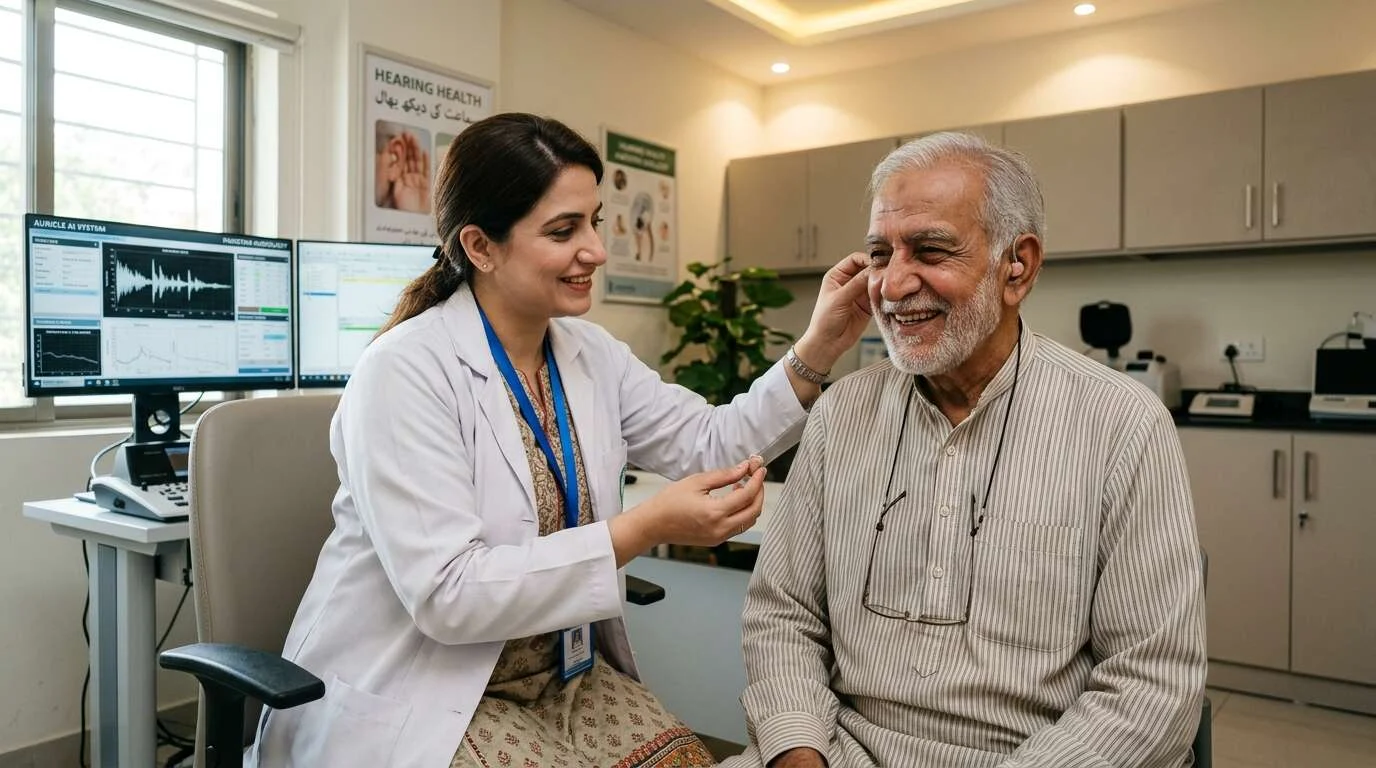
2026 Price guide for AI hearing aids in Pakistan
The cost of AI hearing aids in Pakistan varies based on processing tier, channel count, battery technology, and warranty coverage. Here is the current price benchmark across the Pakistani market:
| Category | Representative Models | Key Features | Estimated Price (PKR) |
|---|---|---|---|
| Premium AI Flagship | Oticon Intent 1, Phonak Lumity 90, Signia 7IX | Deep neural networks, 4D intent sensors, 48 to 64 channels, Bluetooth audio streaming, rechargeable | PKR 280,000 to 450,000+ |
| Advanced AI Standard | Oticon Intent 2 or 3, Phonak Lumity 70, Signia 5IX | Automatic scene switching, dynamic noise reduction, 24 to 32 channels, rechargeable options | PKR 180,000 to 275,000 |
| Mid-Range Smart Digital | Phonak Lumity 30, Signia 3IX, Unitron Moxi | Basic noise reduction, directional microphones, 16 to 20 channels, Bluetooth phone connectivity | PKR 95,000 to 175,000 |
| Basic Digital | Standard digital hearing aids | Feedback cancellation, push-button program settings, standard volume controls | PKR 25,000 to 75,000 |
Why probe tube fitting (REM) makes all the difference
Even the finest AI hearing aids in Pakistan will perform poorly if fitted purely through automated computer estimates. Every person has an ear canal with a unique length, volume, and natural acoustic resonance. When a device is programmed without verifying output in the canal, speech can sound harsh or muffled.
To avoid this, clinical audiology relies on Real Ear Measurement (REM):
-
Precision probe tube placement
The audiologist inserts a micro-probe silicone tube into your ear canal, placing the microphone tip within millimeters of your eardrum. -
Real-world speech testing
The hearing aid is placed in the ear and plays calibrated speech samples through the sound booth speaker across varied decibel levels. -
Acoustic target measurement
The computerized measurement system reads the exact sound pressure hitting your eardrum and displays it on screen against your prescription curve. -
Custom frequency calibration
The audiologist fine-tunes each frequency band until the measured sound output matches your individual auditory loss profile.
Test AI hearing aids risk-free
At Hearing Care Services in Saddar Rawalpindi, every device fitting includes pure tone audiometry in a calibrated soundproof booth, real ear verification, and a 30-day home trial with unlimited aftercare for AI hearing aids in Pakistan.
Frequently asked questions
Can AI hearing aids in Pakistan connect directly to smartphones?
Yes. Current models connect directly through Bluetooth Low Energy to Android phones and Apple iPhones. You can answer calls hands-free, listen to WhatsApp voice messages, and stream videos directly into your hearing aids without an external neckloop.
How long does the battery last on a single charge?
Lithium-ion rechargeable models generally run between 24 and 30 hours per charge, including four to five hours of direct Bluetooth streaming. Placing them in the desktop charger overnight gives you a full day of active use.
Can an AI hearing aid help with severe hearing loss?
Yes. Power BTE models like the Phonak Naida Lumity and Oticon Xceed are built specifically for severe to profound losses. They combine high acoustic output with neural speech processing to keep sounds intelligible without uncomfortable distortion.
Where can I test AI hearing aids in Pakistan?
You can test current models at Hearing Care Services, located on the 1st Floor, Office No. 02, Avalon Plaza in Saddar Rawalpindi. Home visits are also available across Rawalpindi and Islamabad by calling +92-313-5993989.