
Certified Speech-Language Pathology & AVT Clinic
Empowering Confident Speech, Language & Communication
Every voice deserves to be heard clearly. From early childhood language delays and stuttering to post-stroke voice recovery, our certified Speech-Language Pathologists provide warm, individualized therapy to help your family communicate with clarity and joy.
Licensed SLP Pathologists
Play-Based Pediatric Care
Auditory-Verbal (AVT)
Happy Families
Personal Care
Google Verified
Critical brain neuroplasticity period for rapid language gains.
Licensed Speech-Language Pathologists & AVT Practitioners.
Children and adults empowered with clear spoken expression.
Unified hearing diagnostics and verbal therapy center.
Why Early Stage Diagnosis is the Greatest Gift for Your Child
Many parents are advised to ‘just wait and see’ when their toddler isn’t talking or struggles with speech sounds. In audiology and speech pathology, we know that the first 5 years of life offer a golden window of brain development. Early intervention transforms communication frustration into natural, joyful confidence.
Understanding the Impact of Timely Support
When children cannot express their feelings or make their needs understood, it often leads to emotional outbursts, tantrums, and social withdrawal. Addressing articulation and receptive-expressive language challenges early ensures smooth kindergarten transitions and healthy peer bonding.
Our evidence-based pediatric protocols merge playful interactive games with structured oral-motor and phonetic drills, creating an uplifting clinic environment where children love to learn and practice.
If you feel your child is struggling to connect, understand words, or pronounce sounds compared to peers, a gentle diagnostic evaluation provides clarity, peace of mind, and an actionable roadmap.
Faster Resolution & Brain Plasticity
Young neural pathways adapt rapidly to speech drills, shortening the total treatment duration.
School & Reading Readiness
Phonological awareness directly unlocks reading, spelling, and academic excellence.
Emotional Wellbeing & Self-Esteem
Eliminates the frustration of not being understood by teachers, classmates, and relatives.
Parent Empowerment & Home Drills
Learn practical daily conversational games to support your child effortlessly at home.
Speech & Language Milestones Checklist
Compare your child’s current communication patterns against clinical benchmarks to see if a speech consultation is recommended.
First Words & Gestures
- Responds to their name and simple words like ‘No’
- Points to objects of interest and waves goodbye
- Uses 3 to 10 recognizable single words (Mama, Baba, Milk)
No babbling by 12 months, no pointing, or no response to name and auditory cues.
Phrase Building
- Uses 50+ individual words consistently
- Combines two words together (‘Want milk’, ‘Go car’)
- Follows simple 2-step directions (‘Pick up ball and bring it’)
Only echoing words without functional meaning, or speaking fewer than 20 words.
Conversational Flow
- Speaks in complete 4 to 5-word sentences
- Understood by unfamiliar listeners 75% of the time
- Asks ‘Who’, ‘What’, ‘Where’, and ‘Why’ questions
Severe sound omissions, difficulty with sentences, or frequent speech repetitions.
Mastery & Complex Speech
- 100% speech intelligibility to strangers and teachers
- Tells sequenced stories with clear grammatical structure
- Correctly produces complex consonants (/r/, /l/, /s/, /th/)
Persistent lisp, stuttering/stammering blocks, or vocal hoarseness lasting >3 weeks.
Our Comprehensive Speech & Language Protocols
Every diagnosis begins with a warm, child-friendly evaluation followed by a personalized therapy blueprint.
1. Pediatric Articulation & Language Delay Therapy
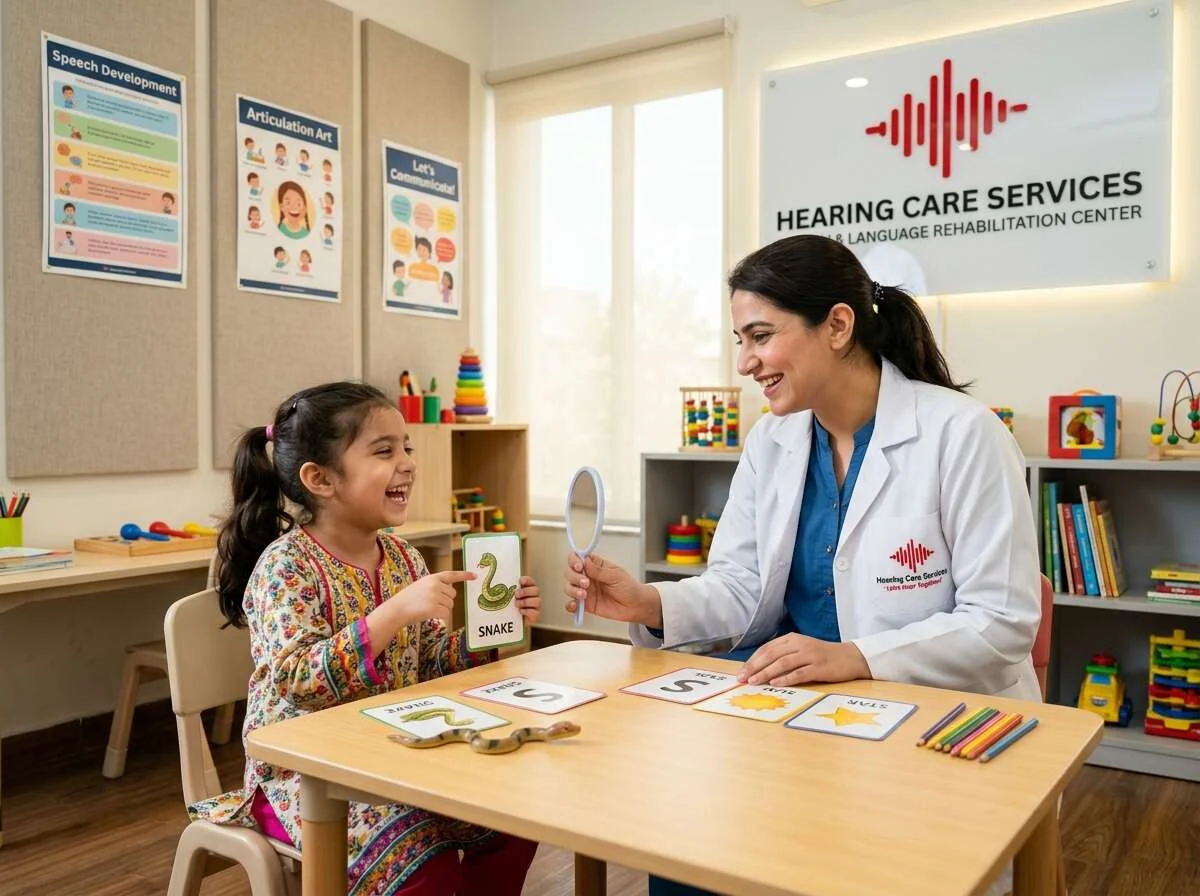
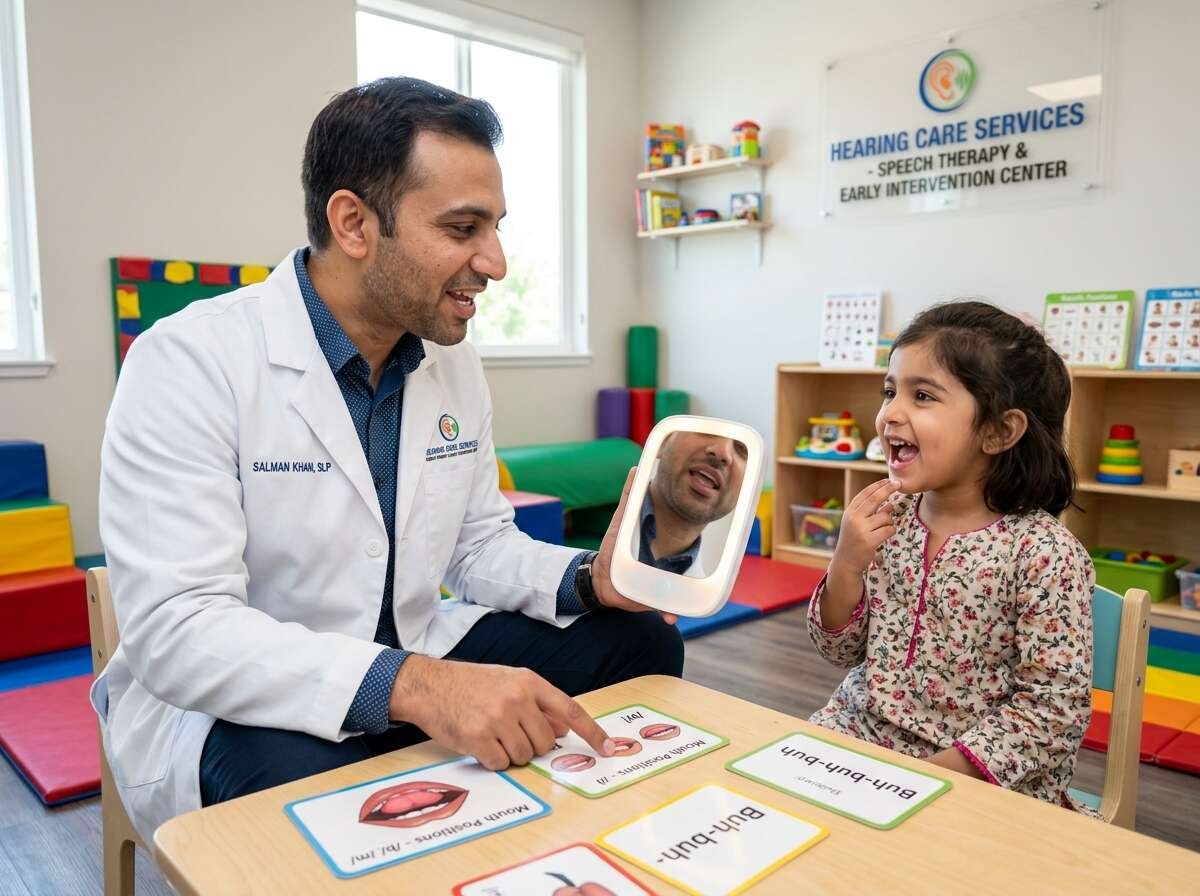
When a child omits, distorts, or substitutes speech sounds (such as saying ‘tat’ for ‘cat’ or ‘wabbit’ for ‘rabbit’), it impacts their confidence and classroom learning. Our certified pediatric speech therapists utilize playful, engaging exercises, mirror feedback, and oral-motor placement techniques to teach correct tongue, lip, and breath placement.
- Correction of lisps, sound substitutions, and phonological processing disorders
- Receptive and expressive vocabulary expansion through structured play
- Autism Spectrum & developmental social communication support (pragmatics)
- Parent training after every session to practice fun speech drills at home
2. Auditory-Verbal Therapy (AVT) for Hearing Impairments
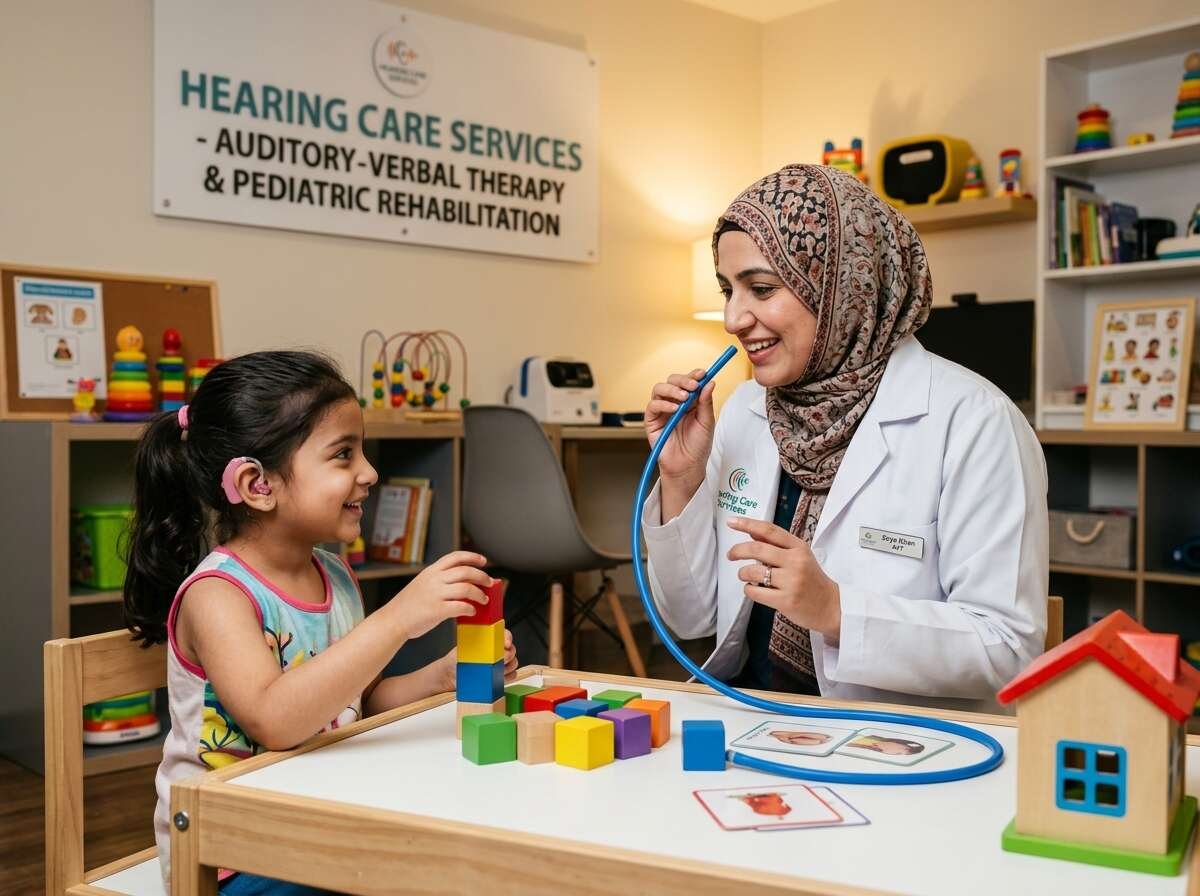
As Pakistan’s leading integrated Audiology and Speech center, we bridge the gap between hearing device technology and natural spoken language. Children with hearing aids or cochlear implants need specialized Auditory-Verbal Therapy to learn how to listen, interpret auditory signals, and develop fluent spoken conversation.
- Maximized use of hearing technology (hearing aids & cochlear implants)
- Listening-first developmental hierarchy (Detection → Discrimination → Identification → Comprehension)
- Integration into mainstream schools without relying exclusively on visual sign
- Real-Ear Measurement (REM) verification in collaboration with our audiologists
3. Fluency & Stuttering (Stammering) Therapy
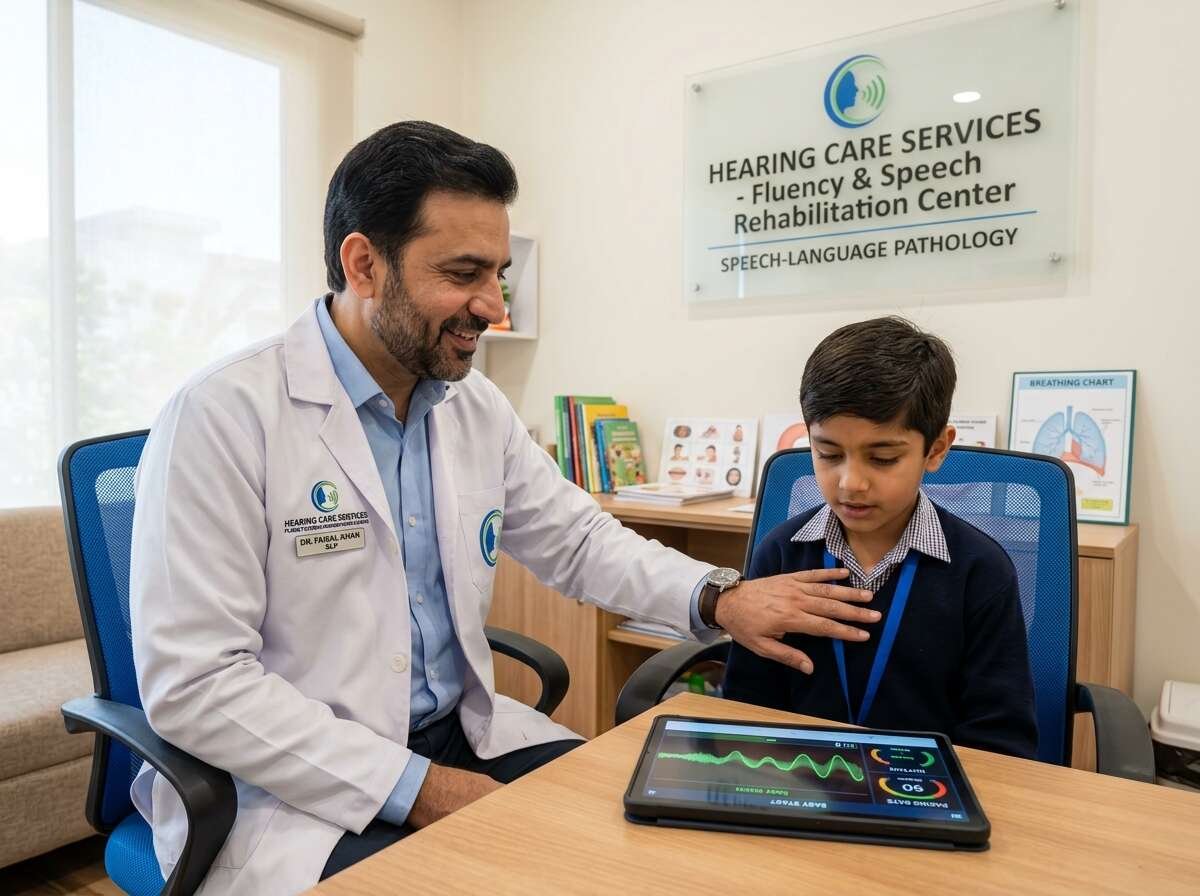
Stuttering involves involuntary sound repetitions, prolongations, or silent speech blocks that can create acute anxiety in social and school environments. Our fluency programs combine clinical speech modification techniques with breathing coordination and psychological desensitization to make speech effortless and calm.
- Reduces speech repetitions, sound prolongations, and physical tension blocks
- Real-time biofeedback software to calibrate speech rate and breathing rhythm
- Psychological desensitization to conquer performance anxiety in school & career
- Tailored programs for young children (Lidcombe approach) and adults
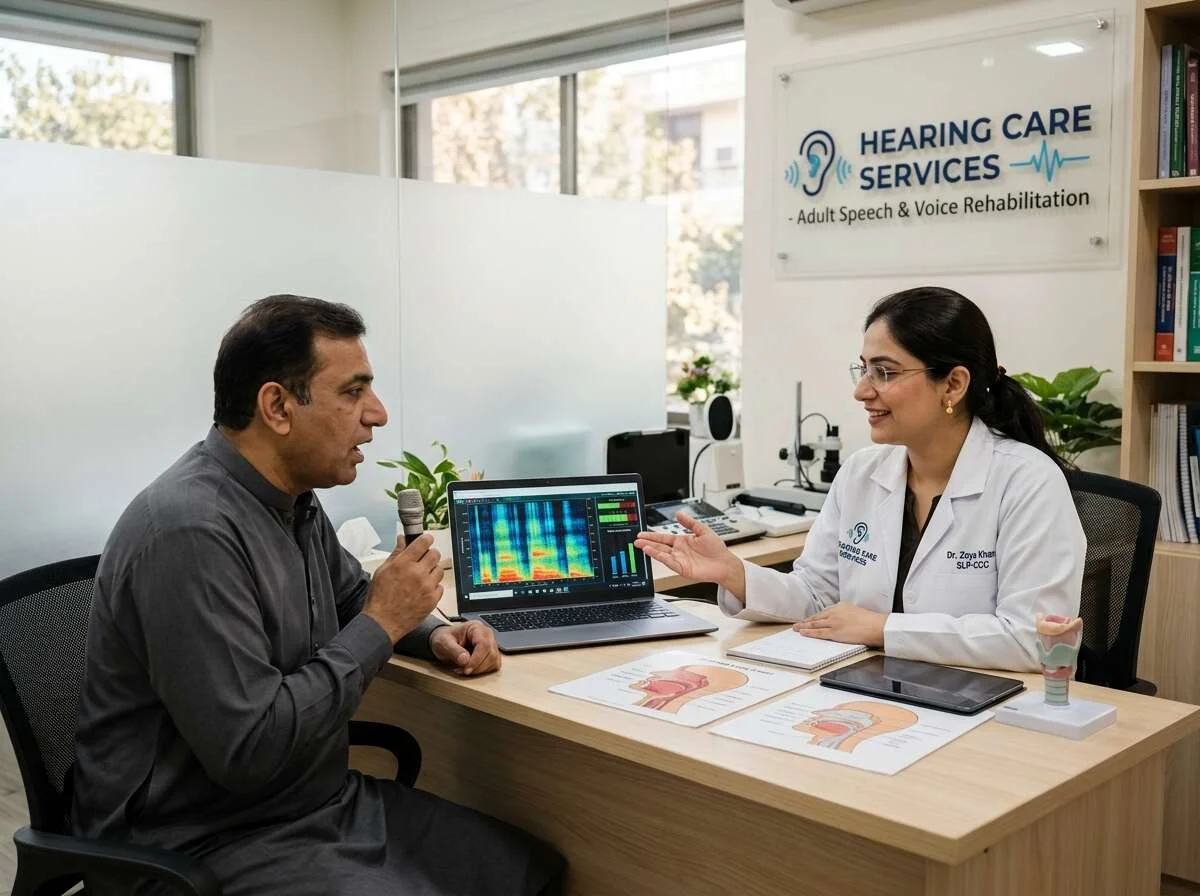
4. Adult Neurogenic Recovery, Aphasia & Voice Therapy
Following a stroke, brain injury, Parkinson’s disease, or chronic vocal cord fatigue (common in teachers, singers, and call center professionals), speaking and swallowing can feel overwhelming. Our adult rehabilitation protocol rebuilds vocal strength, word-retrieval pathways, and motor speech precision with compassionate dignity.
- Post-stroke Aphasia recovery (word finding, sentence building, comprehension)
- Dysarthria & motor speech clarity training (Parkinson’s, ALS, Bell’s Palsy)
- Vocal hygiene & pitch recovery for vocal nodules, hoarseness, and polyp strain
- Safe swallowing therapies (Dysphagia) to prevent aspiration in seniors
Our 4-Stage Speech Therapy Treatment Process
We believe in complete transparency, measurable progress markers, and empowering parents with practical daily tools.
Diagnostic Assessment
A comprehensive 60-minute evaluation assessing oral motor mechanics, articulation clarity, receptive & expressive language scores, and hearing status.
Custom Therapy Blueprint
We formulate a structured, milestone-driven plan with specific, measurable goals tailored to your child’s age, interests, and school needs.
Active Clinical Sessions
Weekly 45-minute 1-on-1 sessions incorporating play-based games, mirror feedback, acoustic biofeedback, and conversational drills.
Home Coaching & Graduation
Parents receive short 5-minute daily home drills. When all milestone goals are achieved, we celebrate your successful graduation!
Speech Sound & Articulation Explorer
Select a speech sound below to learn when children typically master it, common speech substitutions to watch out for, and how our therapists correct it.
Mastered by Age 3 to 4.5 Years
The /s/ sound is a high-frequency fricative that requires a central groove in the tongue and precise airflow behind the teeth.
Interdental lisp (tongue protrudes between teeth producing “Thun” for “Sun”) or lateral lisp (air escapes out sides creating a slushy sound).
How We Teach This Sound:
- Visual Mirror Cueing: Teaching child to keep tongue tip tucked behind closed teeth (“snake sound”).
- Airflow Straw Drills: Directing steady airstream through the central groove.
- Phonetic Hierarchy: Progressing from isolated /s/ → syllables (sa, so) → words → conversational speech.
Mastered by Age 5 to 6 Years
The /r/ sound is one of the most complex phonemes in English and Urdu, requiring both tongue bunching/retroflexion and lateral tongue tension without lip rounding.
Substituting /w/ for /r/ (saying “wabbit” for “rabbit”, “wing” for “ring”, or omitting vocalic r in “car”).
How We Teach This Sound:
- Retroflex vs Bunched Cueing: Finding the child’s natural motor pattern (curled tongue tip vs elevated back).
- Lip Invalidation Drill: Smiling while producing /r/ to eliminate habitual /w/ lip rounding.
- Real-time Spectrogram Feedback: Visualizing acoustic Formant 3 frequency on screen.
Mastered by Age 3.5 to 4.5 Years
The /l/ sound requires elevating the alveolar tongue tip against the roof of the mouth behind the upper incisors while allowing air to flow laterally around the sides.
Substituting /y/ or /w/ for /l/ (saying “yion” for “lion”, or “yemon” for “lemon”).
How We Teach This Sound:
- Tactile Spot Placement: Using a tongue depressor to touch the alveolar ridge spot (“la-la spot”).
- Singing & Rhythm Drills: Repetitive melodic sequences like “la la la” to automate muscle memory.
- Contrast Practice: Discriminating minimal word pairs (Light vs Right, Leaf vs Reef).
Mastered by Age 3 to 3.5 Years
/k/ and /g/ are velar stops produced by elevating the back of the tongue (dorsum) against the soft palate while keeping the tongue tip anchored downward.
Velar fronting (substituting /t/ for /k/ or /d/ for /g/, such as saying “tat” for “cat”, or “doe” for “go”).
How We Teach This Sound:
- Gravity-Assisted Positioning: Practicing sounds while leaning slightly back to naturally allow tongue back to contact palate.
- Anchor Tip Cues: Holding tongue tip down with gentle spatula guidance during initial syllable production.
- Gargling Play: Fun water/air gargling games to awaken velar sensory awareness.
Mastered by Age 5 to 7 Years
The /th/ sound (both voiceless as in “Thumb” and voiced as in “This”) requires placing the tongue gently between upper and lower teeth with continuous airstream.
Substituting /f/ for voiceless /th/ (saying “fumb” for “thumb”) or /d/ for voiced /th/ (saying “dis” for “this”).
How We Teach This Sound:
- Mirror Feedback: Teaching child to visibly see tongue peek between teeth (“peek-a-boo sound”).
- Lip vs Tongue Isolation: Distinguishing /f/ (teeth on bottom lip) from /th/ (tongue between teeth).
- Sensory Feather Cue: Blowing light feathers or paper strips to emphasize sustained airflow.
Frequently Asked Questions About Speech Therapy
Clear answers to common questions from parents and adult patients.
Give Your Child the Power of Clear, Confident Speech
Schedule a friendly, comprehensive diagnostic evaluation with our licensed Speech-Language Pathologists today at Hearing Care Services.
1st Floor, Office No.02, Avalon Plaza, Saddar Rawalpindi • Mon–Sat: 9 Am – 08 Pm