Lithium-Ion Fast Charging
Up to 34h Battery Backup
30-Day In-Clinic Trial
Modern rechargeable hearing aids in Pakistan have largely replaced older disposable button cell models. For decades, hearing aid users in cities like Islamabad, Rawalpindi, and Lahore had to buy zinc-air batteries every five to seven days, constantly worrying about devices dying during family gatherings or office meetings. Today, medical-grade lithium-ion rechargeable systems allow users to place their hearing aids in a charging case overnight and enjoy a full day of speech clarity without handling tiny batteries.
Summary of 2026 Pricing in Pakistan
In Pakistan, clinical digital rechargeable hearing aids range from PKR 95,000 to PKR 160,000 per unit for reliable entry-level devices, PKR 170,000 to PKR 290,000 per unit for mid-tier noise-filtering models, and PKR 320,000 to PKR 650,000+ per unit for premium smart systems with real-time speech tracking and direct Bluetooth streaming.
Table of Contents
Why Switch to Rechargeable Hearing Aids in Pakistan?
The shift toward rechargeable hearing technology in Pakistan is driven by three practical daily benefits:
- Zero Dexterity Frustration: Many elderly patients with hearing loss also experience arthritis or mild hand tremors. Opening tiny plastic battery doors and peeling adhesive tabs off size 10 or 312 batteries is often difficult. With inductive charging, the user simply drops the devices into magnetic slots.
- Protection Against Summer Humidity: Hearing aids with battery doors have open seams where sweat and moisture enter during Pakistani monsoon summers. Rechargeable hearing aids feature sealed unibody housing rated at IP68 water and dust resistance, significantly reducing repair rates.
- Reliable Daily Battery Life: Modern lithium-ion cells provide between 24 and 34 hours of continuous use on a single 3 to 4 hour charge, including 4 to 5 hours of wireless phone calls or audio streaming.
2026 Rechargeable Hearing Aid Price in Pakistan
Hearing aid pricing in Pakistan is determined by the internal computer chip, acoustic channels, and noise-filtering algorithms. Below is the verified pricing across technology categories available at authorized clinics:
| Technology Level | Representative Models | Price Range (PKR / Unit) | Best Suited For |
|---|---|---|---|
| Essential Digital | Signia Prompt R, Phonak Terra+, Oticon Siya | PKR 95,000 – 160,000 | Quiet home environments, one-on-one conversations, television |
| Standard Mid-Tier | Signia Pure Charge&Go AX 3, Oticon Zircon, Phonak Lumity 30 | PKR 170,000 – 290,000 | Family gatherings, shopping markets, moderate background noise |
| Advanced Smart | Signia Pure Charge&Go IX 5, Oticon Real 2, Starkey Genesis AI 16 | PKR 310,000 – 450,000 | Office meetings, busy restaurants, Bluetooth phone calls |
| Premium Flagship | Signia Pure Charge&Go IX 7, Oticon Intent 1, Starkey Genesis AI 24 | PKR 480,000 – 650,000+ | Multi-speaker group conversations, dynamic noisy environments, music clarity |
Note: Prices include official clinical programming, Real Ear Measurement (REM) verification, warranty documentation, and lifetime aftercare fine-tuning.
Top 4 Rechargeable Hearing Aid Models in Pakistan
Signia Pure Charge&Go IX
Built on Signia Integrated Xperience architecture with real-time conversational enhancement to track multiple speakers moving around you in noisy rooms.
Signia Silk Charge&Go IX
One of the only completely-in-the-canal rechargeable hearing aids. Sits discreetly inside the ear canal using soft silicone click sleeves with no behind-the-ear wires.
Oticon Intent
Equipped with 4D sensor technology that monitors head movement, body posture, and acoustic acoustic surroundings to adapt sound delivery to your listening intentions.
Phonak Audéo Lumity
Features AutoSense OS 5.0 with SmartSpeech technology to reduce listening effort in noisy environments. Provides direct Bluetooth streaming to any mobile phone brand.
Managing Load-Shedding and Travel in Pakistan
A frequent question patients ask during clinical consultations is how to manage rechargeable hearing aids during electricity load-shedding or while traveling between cities.
Leading manufacturers offer two types of chargers:
- Standard Desktop Chargers: These sit on your bedside table and remain connected to wall power. A complete charge takes 3 to 4 hours overnight, drawing minimal wattage easily supported by home UPS or solar inverters.
- Portable Travel Chargers (Powerbank Cases): Models like the Signia Charger Plus and Oticon SmartCharger feature built-in lithium-ion powerbanks. The case itself stores up to four full charges, allowing you to charge your hearing aids for days without plugging into an electrical outlet.
Cost Analysis: Rechargeable vs Disposable Zinc-Air Batteries
While rechargeable hearing aids carry a higher initial purchase cost due to the included charger and integrated power management chip, they offer significant operational savings:
| Cost Factor | Disposable Battery Hearing Aids | Lithium-Ion Rechargeable Aids |
|---|---|---|
| Yearly Battery Expenses | PKR 18,000 to PKR 28,000 (roughly 100 to 120 cells per pair) | PKR 0 ongoing battery purchases |
| 3-Year Operational Cost | PKR 54,000 to PKR 84,000 spent on replacement batteries | PKR 0 additional battery cost |
| Environmental Waste | Over 300 toxic zinc-air cells disposed in municipal waste | Single sealed battery lasting 4 to 5 years |
| Daily Convenience | Risk of battery dying unexpectedly during conversation | Consistent full-day performance every morning |
Warning: Rechargeable Sound Amplifiers vs Medical Hearing Aids
When searching for rechargeable ear machine price in Pakistan online, you will encounter cheap devices on e-commerce marketplaces priced between PKR 2,000 and PKR 6,000. It is crucial to understand the clinical difference between these products:
- Cheap Sound Amplifiers: These contain a basic microphone, an analog volume booster, and a generic speaker. They amplify all sounds equally, including fan hum, traffic noise, and sudden clatter. Because they lack selective frequency adjustment or acoustic limiters, they can cause permanent acoustic trauma to remaining hearing.
- Certified Medical Digital Hearing Aids: Prescribed only after a Pure Tone Audiometry (PTA) hearing test. Each channel is calibrated specifically to your individual hearing thresholds, amplifying weak speech consonants while keeping loud sounds at a comfortable, safe volume.
Test Drive Rechargeable Hearing Aids in Islamabad, Rawalpindi, or Lahore
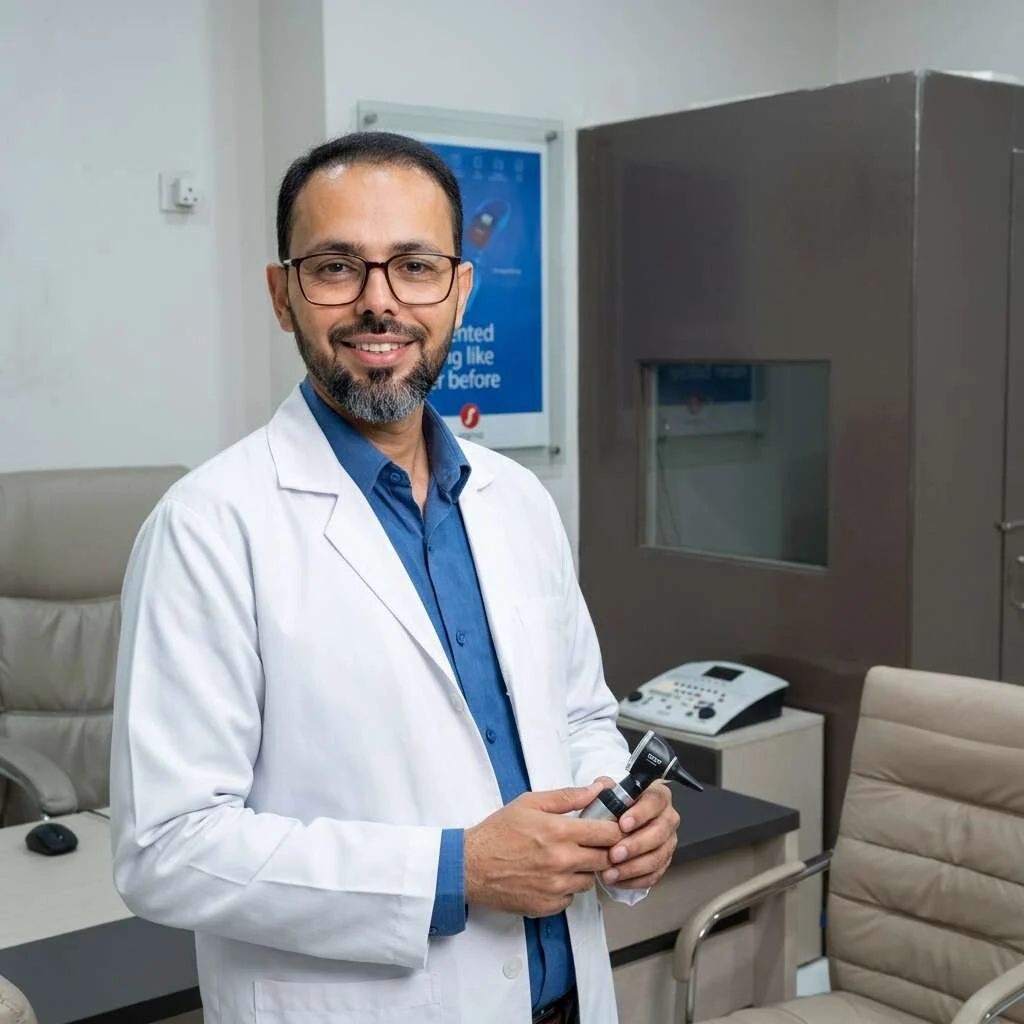
Experience true speech clarity with computerized Real Ear Measurement (REM) calibration and a risk-free 30-day clinical trial at Hearing Care Services.
The Clinical Fitting Process at Hearing Care Services
Fitting a modern rechargeable hearing aid involves precise diagnostic measurement:
- Pure Tone Audiometry (PTA) & Speech Audiometry: Carried out inside a sound-treated booth across 250 Hz to 8000 Hz to map your exact hearing loss profile.
- Video Otoscopy: High-definition inspection of the ear canal and tympanic membrane to ensure there is no earwax impaction.
- Real Ear Measurement (REM): A specialized probe microphone is placed inside your ear canal next to the eardrum while the hearing aid is active. This measures acoustic sound pressure directly at the eardrum, eliminating guesswork.
- Charger Operation & App Pairing: Our audiologist shows you how to dock the devices, clean the microphone ports, and pair the hearing aids with your smartphone for remote volume control.
Frequently Asked Questions
How many years do rechargeable hearing aid batteries last before needing replacement?
Medical-grade lithium-ion hearing aid batteries typically deliver reliable daily service for 4 to 5 years. Unlike smartphones that undergo deep discharge cycles multiple times a day, hearing aid power management chips protect the cells against overcharging and thermal stress. If the cell ever degrades, authorized clinics can replace the internal battery during scheduled servicing.
Can I charge my hearing aids with a mobile phone power bank?
Yes. Most modern charging docks use standard USB-C power cables. You can connect your charging dock to any standard phone powerbank, car USB port, or laptop during road trips or unexpected power outages in Pakistan.
Is it safe to leave hearing aids on the charger all night?
Yes. The charging case features smart automatic shutoff circuitry. Once the lithium-ion batteries reach 100 percent capacity, charging ceases and the charger transitions to a trickle maintenance state, preventing battery damage.
Are rechargeable hearing aids suitable for severe or profound hearing loss?
Yes. High-power rechargeable models such as the Oticon Xceed BTE, Signia Motion Charge&Go, and Phonak Naida Lumity are engineered specifically for severe-to-profound hearing loss, delivering up to 82 dB of gain and 140 dB SPL output while maintaining full-day rechargeable power.